
🔄 Article Update (July 2026): This technical guide has been updated with detailed core diagnostics telemetry, high-resolution sensor fusion workflow diagrams, and structural compute layout schematics.
Introduction: The Era of the Mobile Data Center
The era of the "mechanical-only" car is dead. In 2026, a vehicle is no longer just a chassis, a collection of stamped sheet metal, and an internal combustion or basic electric engine; it is a highly integrated mobile data center. As Artificial Intelligence (AI) migrates rapidly from our smartphones and cloud servers directly into our physical drivetrains, the traditional boundary separating hardware from software has entirely vanished. Here is how AI is fundamentally rewriting the DNA of modern automotive engineering through the deployment of an AI-powered vehicle architecture
Historically, automotive design relied heavily on distributed electronic control units (ECUs), where a single premium car could contain upwards of a hundred localized computers, each running isolated software loops for specific tasks like power windows, braking, or cabin climate control. This legacy approach is fundamentally incompatible with the fast-paced evolution demanded by generative AI, neural networks, and massive computational pipelines. The paradigm shift of 2026 replaces this fragmented approach with a centralized, unified, and highly adaptive electronic nervous system. This transition represents a monumental structural shift towards an integrated AI-powered vehicle architecture that treats the vehicle as a single, holistic computational node capable of continuous learning and adaptation
This deep-dive technical article explores how this architectural transformation impacts every layer of contemporary vehicle engineering. We will examine the transition from simple mechanical wear monitoring to advanced predictive machine learning intelligence, delve into the physics of electric motor core diagnostics via neural telemetry, explore how sensor fusion allows computers to see the invisible road, and analyze the macroeconomic and technical battlegrounds where American and Chinese manufacturers are fighting for autonomous structural superiority
From Mechanical Wear to Predictive Intelligence
The traditional automotive maintenance model has always been reactive or, at best, strictly schedule-based. Drivers changed fluids, inspected brakes, or replaced belts based on elapsed mileage or after an audible component failure occurred. In the context of next-generation electric vehicles (EVs), this method is dangerously inefficient and costly. Today, sophisticated machine learning models integrated into the core of the AI-powered vehicle architecture shift this dynamic entirely from retrospective tracking to real-time, proactive foresight

Figure 1: Complete pipeline of real-time multi-sensor telemetry and hybrid fault diagnostics inside the EV powertrain architecture
The exclusive edge of this technological wave lies in longevity and reliability. While the vast majority of consumer-facing automotive blogs focus almost entirely on the flashier aspects of full self-driving (FSD) beta software and highway lane-merging maneuvers, technical engineers are focused on operational lifespan and structural asset protection. AI is now deeply integrated into the internal motor winding sensors and specialized transformer units of premium electric vehicles. Instead of waiting for an irreversible dielectric or insulation breakdown to trigger a catastrophic component failure, specialized machine learning frameworks—known colloquially as "Neural Diagnostics"—monitor subtle heat signatures, transient thermal anomalies, and high-frequency electromagnetic fluctuations in real-time
The Real-Time AI Impact: Advanced deep learning anomalies algorithms can predict an impending copper coil insulation failure or a micro-leak within the liquid stator cooling loops up to 48 hours before any physical symptoms manifest. This early detection saves fleet operators and individual vehicle owners thousands of dollars in major mechanical overهاuls and completely prevents dangerous on-road thermal runaways
To understand the profound mathematical shift behind this capability, we must evaluate how these systems process live operational telemetry. In a legacy vehicle, thermal monitoring was restricted to a basic thermocouple sending a generic temperature reading to the dashboard. If the motor got too hot, a warning light illuminated. By contrast, a contemporary AI-powered vehicle architecture continuously streams high-fidelity phase-current data, vibrational frequencies, and multi-point thermal variations into a localized neural model. This model cross-references live data against baseline physics profiles to distinguish between standard operational stress and microscopic deviations that indicate real mechanical decay
Deep Dive into EV Motor Diagnostics and Electromagnetic Telemetry
To appreciate how deeply the neural engine penetrates modern hardware, one must look closely at the stator and rotor configurations inside high-performance induction and permanent magnet synchronous motors. Specifically, squirrel-cage rotors and complex stator copper windings are subject to intense electromagnetic, thermal, and mechanical stresses. Over time, these cyclical stresses lead to micro-fissures in the insulation varnish protecting the individual conductor strands
When an insulation fault begins, it alters the local magnetic flux distribution around the affected slots. Integrated into the AI-powered vehicle architecture are highly sensitive magnetic flux leakage sensors and phase-current monitoring loops. These loops continuously log the symmetrical components of the stator current. By applying a real-time Fast Fourier Transform (FFT) combined with a convolutional neural network (CNN), the vehicle's onboard computer analyzes the harmonic distortion components of the electrical current. The neural framework evaluates specific fault-indicative frequencies, defined mathematically as
Where fs represents the supply frequency, R is the number of rotor slots, s is the motor slip, p represents the number of pole pairs, and n indicates the harmonic order. By recognizing minute changes in these specific spectral sidebands, the onboard Neural Diagnostics suite pinpoints the precise location of a degrading winding turn before an internal short-circuit occurs. This level of granular visibility ensures that maintenance is converted from an emergency breakdown scenario into a highly controlled, predictable, and modular component service
| Diagnostic Dimension | Legacy Sensor Paradigm (Pre-2024) | AI-Powered Architecture Paradigm (2026) | Primary System Benefit |
|---|---|---|---|
| Stator Winding Monitoring | Static thermocouple over-temperature alerts | Real-time CNN-based phase current harmonic analysis | Prevents catastrophic short-circuits via 48-hour advanced warning |
| Rotor Core Inspection | Post-failure physical teardown and visual checks | Electromagnetic flux symmetry neural evaluation | Eliminates structural breakdown risks in squirrel-cage assemblies |
| Cooling Loop Integrity | Fluid level pressure sensors and drop thresholds | Predictive thermal transient pattern matching | Identifies micro-leaks prior to electronic fluid contamination |
Computer Vision: Seeing the "Invisible" Road
Beyond the internal electrical powertrain, the external sensory apparatus of modern vehicles has undergone an equally radical computational rebirth. Modern computer vision sub-systems do not simply "see" the car directly in front of them or track painted highway lane dividers; they calculate deep probabilistic states of the entire surrounding environment. Through the sophisticated deployment of Sensor Fusion—a structural technique that mathematically fuses disparate data streams from ultra-high-resolution cameras, solid-state Lidar modules, and high-frequency digital Radar arrays—the 2026 AI-powered vehicle architecture creates a dynamic, 360-degree real-time volumetric occupancy grid
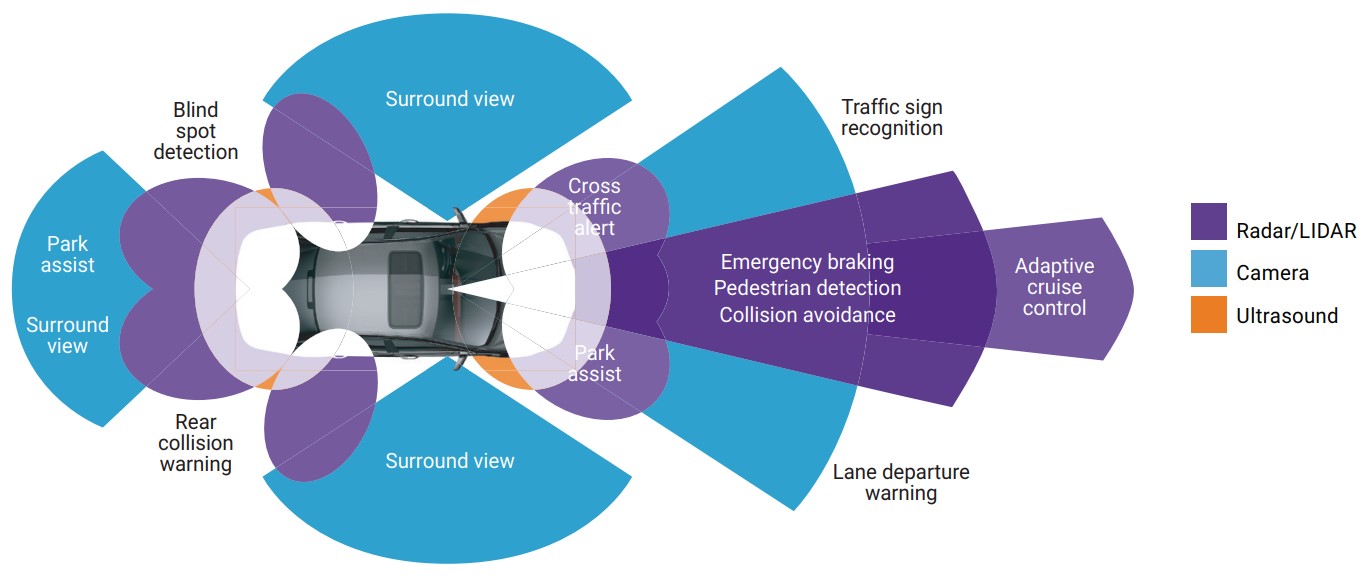
Multi-sensor fusion layout displaying overlapping detection sectors for Cameras, Radar/LiDAR, and Ultrasound sensors
This complex occupancy grid functions as a digital twin of the physical world. Instead of processing individual pixels as isolated fragments, the vehicle’s central transformer models interpret the visual scene holistically. For instance, if a pedestrian is obscured behind a parked delivery van, a legacy vision system would fail to register their presence until they stepped directly into the vehicle's driving path. A modern system, however, tracks contextual clues: the shadows cast underneath the van, the behavioral patterns of surrounding traffic, and historical spatial data from the immediate urban environment. By running millions of forward-looking simulations per millisecond, the neural engine predicts the probability of a pedestrian emerging onto the asphalt, preemptively adjusting the braking pressure and torque vectoring before the hazard is even visible to the human eye
Through this integration, sensor fusion models are now resilient against extreme weather degradations. Heavy rain, dense fog, and blinding sun glare traditionally crippled early automated driving assistance systems. In 2026, if a high-definition camera is temporarily blinded by oncoming high-beam headlights, the AI-powered vehicle architecture seamlessly shifts the primary mathematical weights of its spatial perception layers to the digital radar and solid-state Lidar arrays. This dynamic cross-validation ensures that the vehicle's underlying predictive path-planning algorithm always receives an uncompromised, structurally verified stream of spatial awareness data, maintaining absolute navigational safety under all operational constraints
Centralized Compute vs. Legacy Zonal Architecture
The practical implementation of these highly demanding machine learning models requires an absolute rejection of traditional automotive electronics computing frameworks. In the past, auto manufacturers added functionality by simply adding more independent chips from various Tier-1 suppliers. This created a chaotic, uncoordinated network that suffered from immense transmission latency, massive wiring harness weight, and severe software update bottlenecks. The modern solution is a highly optimized, centralized computing platform that forms the foundational bedrock of any advanced AI-powered vehicle architecture

Core processing architecture combining discrete CPU, GPU, and NPU computing clusters to execute massive automotive AI workloads
By migrating computational power away from the edges of the vehicle into a central "supercomputing core," manufacturers have achieved a massive consolidation of hardware. This core is typically powered by multi-chip monolithic processors running heterogeneous compute environments—combining massive graphic processing clusters (GPUs) for vision models, dedicated neural processing units (NPUs) for deep learning acceleration, and ultra-secure, lock-step CPU cores for critical safety-actuation systems. This centralized layout allows data to flow instantaneously across a unified high-speed automotive Ethernet backbone, bypassing the slow data transfer constraints of older Controller Area Network (CAN) and Local Interconnect Network (LIN) standards
Furthermore, this architectural consolidation significantly reduces the physical weight and complexity of the vehicle’s internal wiring harnesses. By organizing the physical connections into localized, dumb "zonal gateways" that act purely as data-concentration points and power-distribution hubs, engineers can eliminate kilometers of redundant copper wiring. The data is aggregated at these local zones and blasted directly to the central neural engine via fiber-optic or high-bandwidth twisted-pair cabling. This structural layout not only improves production efficiency on assembly lines but also drastically boosts overall vehicleenergy efficiency, extending battery range and lowering production costs simultaneously
The Neural Engine: How AI and NVIDIA Drive Thor Are Redefining Vehicle Architecture
The Ultimate Guide to Software-Defined Vehicles Architecture
REDTIGER F7NP 4K Front and Rear Car Dash Camera
Enhance your driving safety and secure absolute proof on every journey with the ultimate smart co-pilot. The REDTIGER F7NP features stunning 4K front-facing and 1080P rear video quality to capture the finest roadside details.
Ideal for daily commutes, long road trips, and active continuous surveillance loops.
Connect & Follow My Work
Stay updated with the latest tech insights and automotive innovations. Follow my official profiles across these platforms to connect directly:
Comments
Post a Comment
We welcome your opinions and constructive discussions.